
Decompose, Compare, and Decide:
Multimodal LLMs are Implicit Few-Shot Learners

Abstract
Multimodal Large Language Models (MLLMs) have demonstrated remarkable abilities when analyzing images, yet translating these capabilities to few-shot image classification remains challenging. To bridge this gap, we present DeCoDe, a simple yet effective technique that enables off-the-shelf MLLMs to act as strong few-shot classifiers without any additional training. Our approach builds on the idea of few-shot classification as a set of pairwise image comparisons, decomposing the task into a set of binary decisions. Given a query image and a support image from a candidate class, the MLLM is prompted to decide whether the two images depict the same class. The logit corresponding to an affirmative response is then used as a similarity score to assign the query image to the most likely class. While this already yields good results, we show that providing additional high-level information, such as the data domain, to the model further improves performance. Our evaluation provides an extensive analysis of various inference variants on a suite of twelve datasets, six established and six newly curated few-shot benchmarks spanning across diverse domains. The results show that the proposed simple decomposition technique can turn off-the-shelf MLLMs into powerful few-shot learners, significantly outperforming current state-of-the-art few-shot methods on both standard and novel domains.
Results Overview

- MLLMs can already achieve saturated performance 0-shot on standard datasets, while 1-shot hurts performance. Indicating strong dominance of semantic prior.
- The trend reverses on novel datasets, where 1-shot prompting is beneficial, but DeCoDe still outperforms it.
- When switching to anonymous class labels, 1-shot prompting collapses to near-random, DeCoDe maintains its effectiveness.
- Dataset-domain information generally provides an additional gain, especially on novel domains.
Additional Results
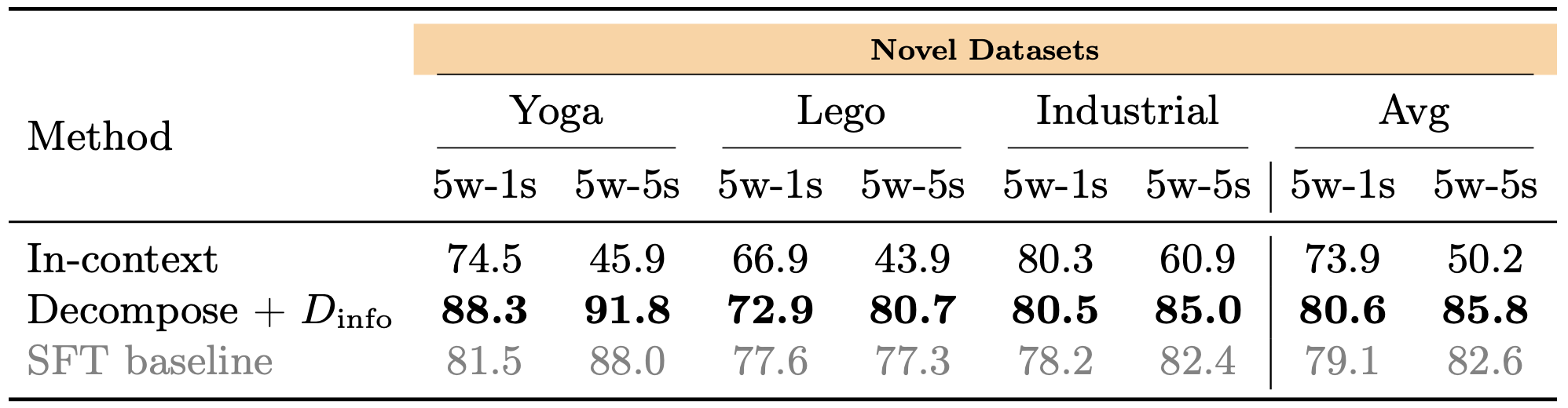
Scaling with more shots
With more support examples, direct in-context prompting drops from 73.9% to 50.2% average accuracy. DeCoDe with domain information instead improves from 80.6% to 85.8%, surpassing the supervised fine-tuning baseline.

Scaling with the number of classes
As the task grows from 3-way to 20-way classification, in-context accuracy deteriorates sharply. DeCoDe remains substantially more robust across standard and novel datasets, with the performance gap widening at larger values of N.
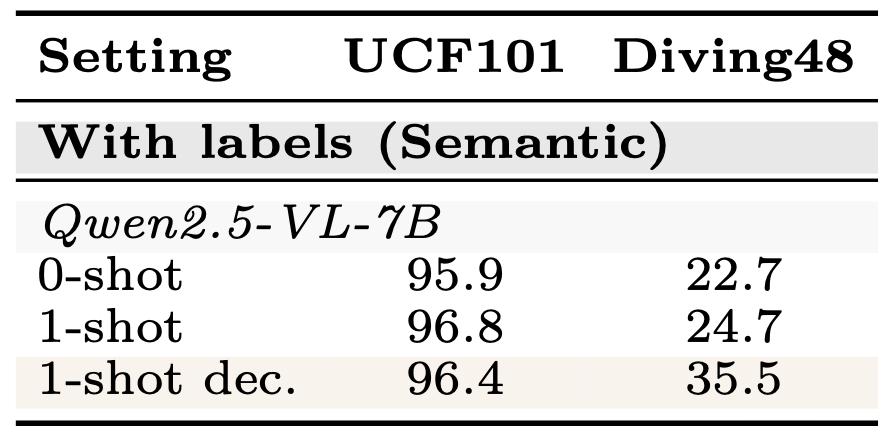
Few-shot video classification
UCF101 is already near saturation for Qwen2.5-VL. On the more fine-grained and temporally sensitive Diving48 dataset, decomposed 1-shot prompting improves accuracy from 24.7% to 35.5%, indicating that the approach also extends to few-shot action recognition, while the model has not been specifically trained on multi-video input and highly dynamic videos.
BibTeX
@misc{wang2026decomposecomparedecidemultimodal,
      title={Decompose, Compare, and Decide: Multimodal LLMs are Implicit Few-Shot Learners},
      author={Yunhan Wang and Eshika Khandelwal and Edson Araujo and Walid Bousselham and Nina Shvetsova and Hilde Kuehne},
      year={2026},
      eprint={2607.00125},
      archivePrefix={arXiv},
      primaryClass={cs.CV},
      url={https://arxiv.org/abs/2607.00125},
}